
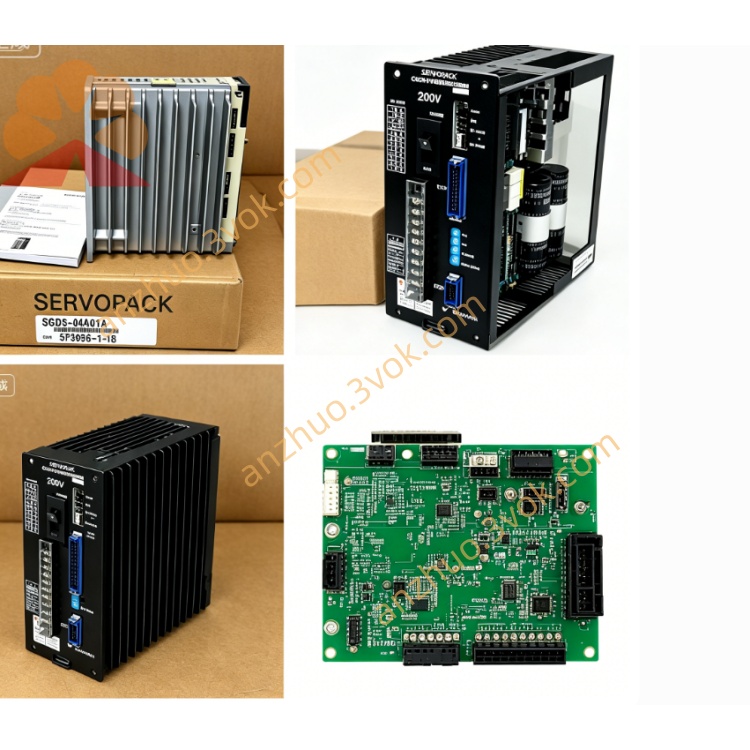
Yaskawa CACR-SR20BB1BM Digital Servo Drive
The CACR-SR20BB1BM is a 2.0 kW digital AC servo drive of Yaskawa CACR-SR (VS-800) series, designed for traditional CNC machine tools and high-precision industrial automation systems. It adopts built-in forced air cooling, with 18.8 A continuous current and 45 A short-term peak current. Equipped with absolute encoder interface and universal base firmware, this drive features reliable position retention and wide system compatibility, suitable for equipment requiring accurate absolute position detection and stable servo operation.
Description
Model Definition
CACR: AC servo drive (SERVOPACK) product familySR: VS-800 series for integrated speed and position control20: 2.0 kW rated output powerB: Three-phase 200–230 VAC main power supply specificationB: Standard general-purpose hardware configuration1: Single-phase 200–230 VAC control power supplyB: Standard analog control interfaceM: Absolute encoder signal interface for motor feedback
Technical Specifications
Electrical Parameters
Main power supply: 3-phase 200–230 V AC, tolerance -15% to +10%, 50/60 HzControl power supply: 1-phase 200–230 V AC, tolerance -15% to +10%, 50/60 HzDC bus voltage: Internal integrated DC bus circuitContinuous output current: 18.8 APeak output current: 45 A for short-time operationOutput frequency range: 0 Hz to 400 HzPower dissipation: Approximately 150 WCompatible motors: Yaskawa S-series servo motors equipped with absolute encoders
Mechanical & Environmental Parameters
Cooling method: Built-in forced air cooling with internal fanProtection class: IP20 for the whole unitOperating temperature: 0 °C to +55 °CStorage temperature: -20 °C to +85 °CMaximum installation altitude: 1000 m, 1% performance derating per 100 m above 1000 mVibration resistance: 0.5 g (10–60 Hz), 0.2 g (60–200 Hz)Dimensions (H×W×D): 380 mm × 150 mm × 200 mmWeight: Approximately 6.0 kg
Interface and Communication Configuration
Motor feedback: CN2 interface supporting absolute encoder signalsSystem bus: Internal bus design for signal transmissionMain power interface: R, S, T for main power input, L1, L2 for control power input, U, V, W for motor outputRegenerative interface: P, B terminals for external regenerative resistor connectionControl I/O: CN1 50-pin interface with multiple isolated digital inputs and outputsAnalog interface: ±10 V DC analog command input and speed monitoring outputCommunication: RS232 and RS485 interfaces supporting Modbus RTU protocolDisplay unit: Seven-segment LED display for operating status and alarm codes
Core Functions
Current, speed and position three-loop control ensures stable and high-precision motion performance.Absolute encoder interface keeps real position data after power off without repeated homing operation.Standard analog control interface and universal hardware deliver excellent compatibility with mainstream control systems.Complete protection against overvoltage, undervoltage, overcurrent, overheating, encoder fault and overload.Supports torque, speed and position control modes to meet various working conditions.Compact vertical structure adapts to standard industrial control cabinet installation.Mature hardware design ensures long-term continuous operation in industrial environments.
Application Scenarios
Legacy CNC lathes, milling machines and machining centers using absolute encoder servo systemsAutomation equipment requiring power-off position retention and no repeated homingRotary positioning tables, material handling and high-precision conveying equipmentVS-800 series servo system replacement and production line renovation projectsGeneral industrial machinery with high requirements for positioning accuracy and operational efficiency
Usage and Maintenance
Maintain smooth air circulation inside the cabinet to guarantee heat dissipation effect.Keep ambient temperature within the standard range to prevent performance decline.Complete wiring of power, feedback, control and communication circuits before power-on.Verify the connected motor is matched with absolute encoder to ensure normal operation.Clean heat dissipation components and air passages every six months, and inspect terminal connections regularly.Calibrate control loops, feedback signals and communication status once a year to maintain long-term stable operation.
Get a Quote