
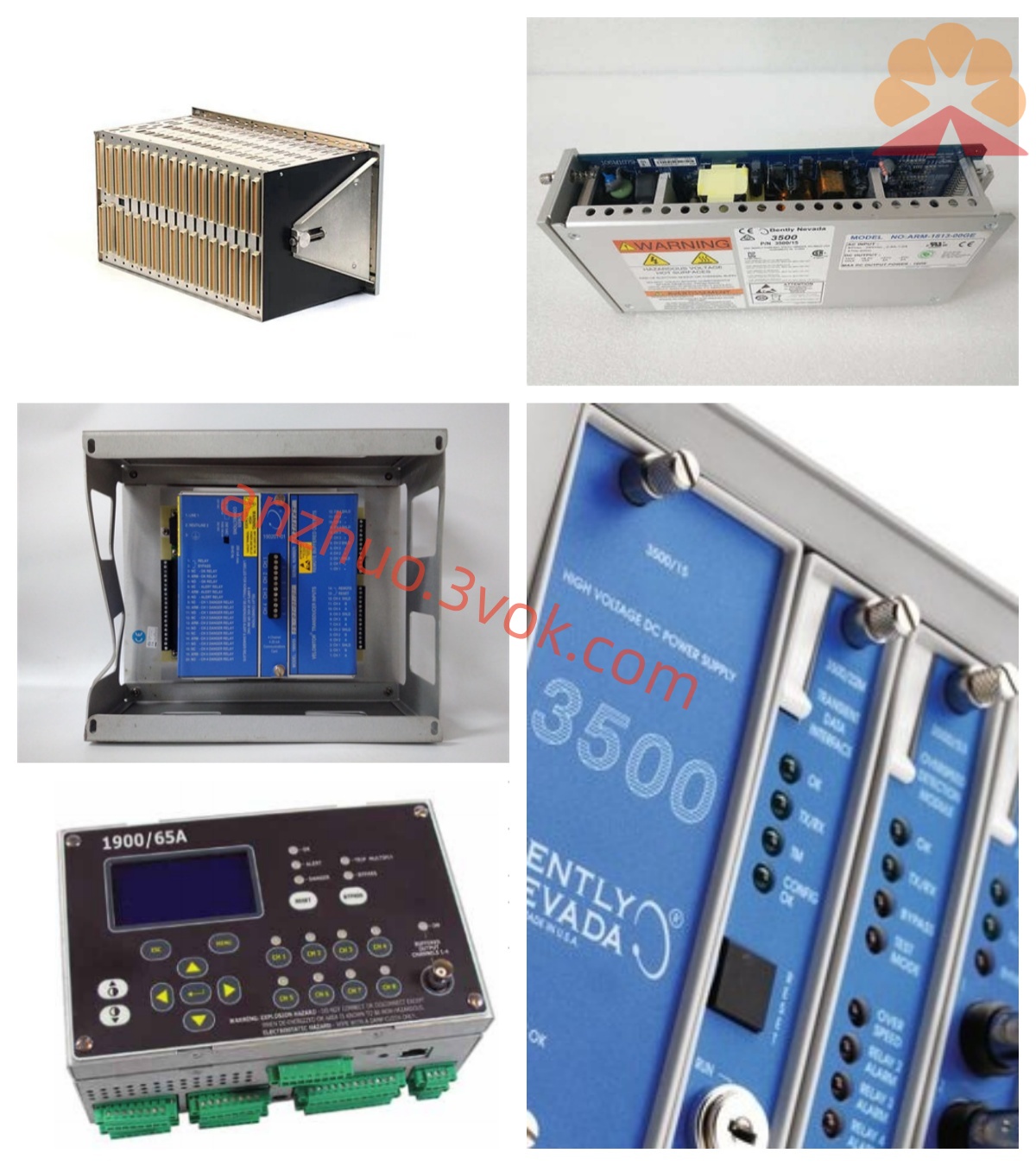
Bentley 3300/16-03-01-00-01-00-00 Product Description
Description
Bentley 3300/16-03-01-00-01-00-00 Product Description
I. Product Introduction
The Bentley 3300/16-03-01-00-01-00-00 is a dual-channel XY/GAP vibration and shaft clearance monitoring module of the Bentley Nevada 3300 series under Baker Hughes. It is mainly used for online condition monitoring and safety protection of large industrial rotating machinery. This module integrates dual-channel radial vibration and synchronous monitoring of shaft and bearing clearance functions, and can collect real-time data of equipment operation, accurately identifying fault hazards such as rotor imbalance, misalignment of the shaft system, bearing wear, and deviation of the shaft position. The equipment integrates multiple functions such as data acquisition, local display, status alarm, self-diagnosis of faults, remote communication, etc., using a standard modular design, compatible with the 3300 series dedicated chassis, with excellent electromagnetic compatibility performance, stable and reliable operation, and widely used in key units of power, petrochemical, metallurgy, water supply and other industries, providing guarantees for equipment fault early warning, operation control and safety interlock.
II. Basic Information
This product is produced by Bentley Nevada and belongs to the 3300 industrial condition monitoring series. The model is 3300/16-03-01-00-01-00-00. The equipment type is a dual-channel radial vibration and shaft clearance integrated monitor. The core functions include dual-channel vibration amplitude measurement, gap voltage collection, calculation of the average position of the shaft, output of over-limit alarms, hardware self-diagnosis, remote parameter configuration and data monitoring. The product is compatible with 3300 XL, 7200 series eddy current probes and their accompanying preamplifiers. The standard probe sensitivity is 200mV/mil, suitable for mainstream sensing devices in industrial sites. The entire machine is installed in a 19-inch standard rack, and can be directly embedded in the same series monitoring chassis. The product complies with CE electromagnetic compatibility standards and can operate continuously in industrial sites with high dust content, complex electromagnetic environments, and large temperature and humidity fluctuations.
III. Functions and Positioning
The module is equipped with two completely isolated independent measurement channels, and the signals between the channels do not interfere with each other. It can simultaneously monitor the radial vibration in the X and Y directions of a single equipment, or separately monitor the parameters of two different rotating equipment. The two sets of data are independently calculated, and the alarm logic is independent. The equipment continuously collects the gap voltage between the shaft and the bearing while measuring the vibration amplitude, converts it into the average operating position of the shaft, and realizes dual monitoring of vibration and shaft system position, comprehensively grasping the operating conditions of the rotor and bearings.
The equipment is equipped with two-level warning and danger alarm mechanisms. The alarm threshold and alarm delay of each channel can be independently set through the local panel or the upper-level monitoring software. When the monitoring parameters exceed the preset limit, the corresponding status indicator light on the panel lights up, and an alarm signal is output simultaneously. It can be connected to on-site sound and light alarm devices and the unit interlock system to achieve graded safety protection. The module supports single-channel or dual-channel bypass functions. During sensor calibration, line maintenance, and equipment maintenance, the alarm output can be temporarily shielded without affecting the normal operation of other system functions, ensuring the uninterrupted operation of the monitoring system.
An advanced fault self-diagnosis circuit is built-in, which can detect sensor breakage, line short circuit, abnormal input signals, and hardware faults of the module itself. When an abnormality occurs, the operating status indicator light goes out, promptly alerting maintenance personnel to carry out fault troubleshooting. The module has a sensor signal buffer output interface that can be externally connected to oscilloscopes, data acquisition instruments, etc., for on-site signal verification, equipment debugging, and in-depth analysis of faults. This model does not have additional analog output configuration and has special industry certification. It does not carry an internal safety barrier and is a general monitoring machine suitable for specific industry regulations.
IV. Core Performance Parameters The input signal of the equipment is the gap voltage output by the eddy current preamplifier, and the reference voltage is -24V DC. The two input channels adopt a high input impedance design to effectively avoid attenuation during signal transmission. The frequency response is divided into two working modes: the high-frequency mode has a frequency range of 4Hz to 4000Hz, suitable for various high-speed rotating mechanical equipment; the low-frequency mode has a frequency range of 1Hz to 600Hz, suitable for low-speed units. The low-frequency mode is not recommended for equipment with an acceleration rate exceeding 1000rpm/s, to prevent data distortion during monitoring.
The full-scale range of vibration measurement is 0 to 250 micrometers peak-to-peak, with a measurement accuracy of ±1% of the full scale. The gap voltage measurement range is -2V to -22V DC, with a voltage measurement accuracy of ±0.1V. The display resolution of the panel is 0.1 micrometers and 0.1V DC, with clear and precise readings. The power supply can be selected as -18V DC or -24V DC. The module is equipped with an independent current-limiting protection circuit, and the maximum power consumption of the entire machine does not exceed 5W. The power supply voltage fluctuates within the range of ±10% of the rated value, and the equipment can operate stably and normally.
The alarm system is divided into two levels: warning and danger. Each channel is independently configured. The rated parameters of the relay contacts are 24V DC and 1A, supporting the switching between normally open and normally closed modes. The alarm delay time can be programmed within the range of 0 to 10 seconds, effectively filtering instantaneous interference signals and reducing the probability of false alarms.
In terms of environmental adaptability, the normal operating temperature range of the equipment is -40℃ to +70℃, the storage temperature range is -52℃ to +105℃, and the applicable relative humidity is 5% to 95%. The operating environment requires no condensation. The front of the equipment is equipped with an LED digital display, which can freely switch to view the vibration values and gap voltages of the two channels. It is also equipped with independent status indicator lights for operation, bypass, warning, and danger. The module integrates an RS-485 communication interface, which can be connected to the upper computer of the system to complete remote parameter configuration, real-time data reading, and alarm status monitoring.
VII. Model Code Explanation
3300 is the general code for the 3300 series products of Bently. 16 represents the XY/GAP dual-channel vibration and shaft gap monitor, 03 represents the full-scale vibration measurement range of 0 to 250 micrometers peak-to-peak, 01 represents the standard 3300/7200 probe system, with a standard sensitivity of 200mV/mil, 00 represents no analog output configuration, 01 represents having special industry certification, 00 represents no built-in safety barrier, and the last 00 represents the standard basic version without additional customized functions.
VIII. Applicable Equipment Fields
The power industry is mainly applied to steam turbine generator sets, boiler induced draft fans, supply fans, large circulating water pumps, etc. of power station core auxiliary equipment. The petrochemical industry is suitable for centrifugal compressors, screw compressors, high-temperature process pumps, and complete sets of refining and chemical units, etc. of continuous operation of key rotating equipment. The metallurgical industry can be used for blast furnace blowers, rolling mill units, dust removal fans, etc. of equipment for online status monitoring. It is also applicable to large-scale circulating water pumps of water supply systems and various medium-high-speed rotating machinery in industrial and mining enterprises. Relying on the compliance certification advantage, it can meet the usage specifications of corresponding industries, providing reliable support for equipment condition assessment, early fault warning, and safety interlock shutdown.
IX. Installation and Maintenance Key Points
The equipment is installed in a 19-inch standard rack. During assembly, sufficient spacing is reserved between the modules to ensure ventilation and heat dissipation, avoiding temperature accumulation that affects the operating performance. During the wiring operation, it is necessary to strictly distinguish between A and B signal channels, positive and negative power terminals, relay output terminals and communication terminals. Follow the marking specifications for wiring to avoid incorrect or reverse connections, which could cause equipment damage or abnormal monitoring data. It is recommended to perform channel accuracy calibration using original factory standard probes and calibration tools every six months. After calibration, lock the parameters to prevent unauthorized personnel from随意 modifying the settings.
During daily operation, keep the equipment panel and the interior of the cabinet clean. Prevent dust and oil from entering the module. Regularly inspect all wiring terminals and promptly tighten loose lines to avoid signal jumps caused by poor contact. When the equipment triggers fault alerts or abnormal alarms, gradually locate the problem by first checking the sensors and connection lines, and then testing the monitoring module itself. When using the low-frequency working mode, do not apply it to fast-start and stop units to prevent monitoring data from deviating. Communication lines should be kept away from strong power cables to reduce the impact of electromagnetic interference on signal transmission. This model has industry-specific certification. During use, it is strictly prohibited to disassemble or modify the hardware structure privately to ensure that the equipment complies with operation specifications.
Get a Quote